
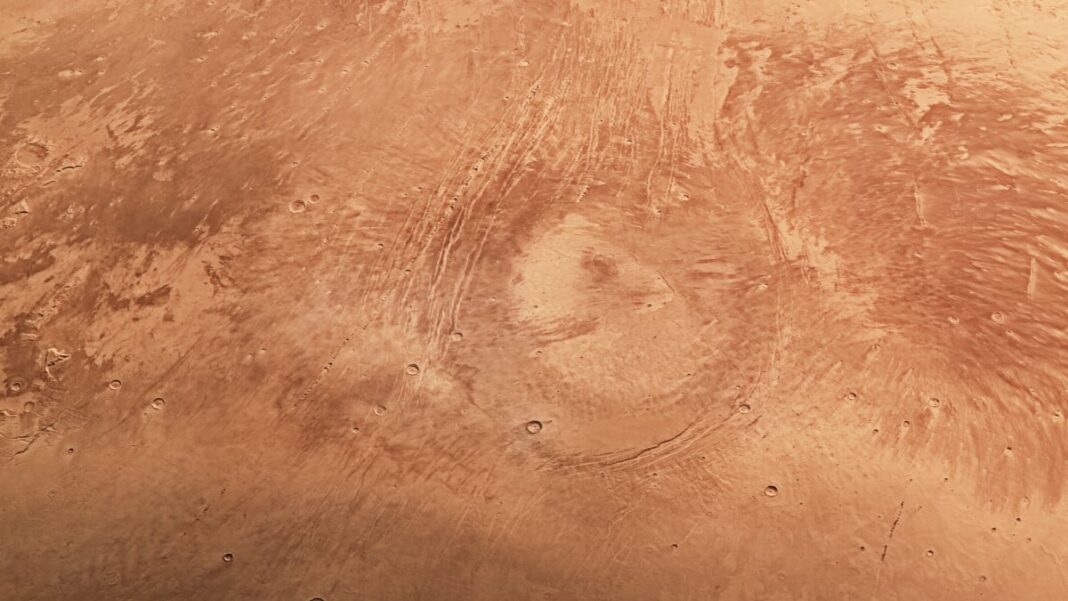

Though Mars has the largest volcanoes in the solar system, many scientists have claimed they are long-extinct. No one has ever seen smoke or lava erupting from their towering summits.
But new evidence from a European spacecraft may force researchers to rethink that assumption: Maybe these volcanoes are not dead after all — just dormant.
The shakeup comes from new research led by Alexander Trokhimovskiy, based on data from the European Space Agency’s ExoMars Trace Gas Orbiter (TGO), which studies gases in the Red Planet’s air from space. The orbiter detected hydrogen chloride near Alba Mons, which sits in the northern hemisphere. The chemical is a foul-smelling gas that often vents from volcanoes. Nothing in Mars’ weather or air chemistry points to why the gas collects in this one area.
Two cameras, Cassis and NASA‘s Hirise, also spotted fresh narrow cracks — some just inches to a foot or two wide — in the ground beneath where the gas appeared.
“Our findings suggest that Mars has retained enough internal heat to support volcanic activity until recently,” said Daniel Mège, co-lead author from the Space Research Centre of the Polish Academy of Sciences, in a statement, “and possibly still does.”
These observations, published in Science Advances on Wednesday, are clues that Mars may still be volcanically active, not just billions of years ago, with magma — hot, melted rock — still coursing beneath its surface. Mège has gone so far as to call the hydrogen chloride detection the “smoking gun.” If true, Mars may have warm, wet pockets underground where life could survive.
Despite the common belief that Mars’ volcanoes are dead, scientists have spotted subtle clues over the years that they may not be. NASA’s Insight lander, for example, recorded marsquakes, which could indicate magma movement is shaking the ground. Some hardened lava flows and ash eruptions in Tharsis, a huge volcanic plateau that includes Alba Mons, have been dated to only tens of millions of years ago, along with some in two other volcanic regions. Computer simulations suggest heat rising from deep inside Mars could still be melting rock under the plateau today.
What scientists haven’t found is a clear sign of activity. Searches for heat or visible changes at the surface have come up empty. So has the hunt for sulfur dioxide, the gas scientists usually look for.
Mashable Light Speed
But the missing gas doesn’t mean Mars’ volcanoes are completely tapped out, the researchers say. Even on Earth, volcanoes don’t always release it. After an eruption ends, a volcano often gives off little sulfur dioxide but continues leaking hydrogen chloride because the latter dissolves in the oozy melted rock below the surface.
Martian rocks and soil also carry more chlorine compared to their water and sulfur than Earth rocks do. The research team figures that makes hydrogen chloride likely one of Mars’ most common volcanic gases.

In this global map, the north pole is at the bottom and the equator is at the top.
Credit: NASA / MGS / MOLA Science Team / FU Berlin infographic
The orbiter first detected the hydrogen chloride in Mars’ thin air in 2020. The gas usually follows the seasons, accumulating in northern winter and dissipating by summer, rising and falling with the planet’s dust and water cycles.
One spot didn’t follow that pattern. Every early northern summer the researchers checked, the gas surged in the same place — above cracks on the slopes of Alba Mons. Some of the cracks are in clusters stretching for miles, running along ridges up to about 100 feet high. The cracks cut through an icy surface layer that formed only about 630,000 years ago, which means they showed up sometime more recently. On a geological timescale, that would date them to practically yesterday.
The spacecraft measured the gas by looking through the Martian air toward the sun. The study focused on 78 of these observations over the region. The fact that the orbiter caught a handful of gas molecules from a source that may switch on only now and then surprised even the scientists.
“These findings may prove to be TGO’s greatest success yet,” said Colin Wilson, the European Space Agency’s project scientist for the spacecraft.

Spacecraft first detected hydrogen chloride in Mars’ thin air in 2020.
Credit: NASA / MOLA Science Team
The team thinks volcanic gases spew out of the cracks, much like the vents on Earth. In winter, temperatures drop to -184 degrees Fahrenheit, allowing ice to seal the openings. When summer arrives, the ice turns straight into vapor, skipping over the liquid phase. The escaping gas may leave deposits behind, according to the research, which could explain discoloration around the cracks.
Gases like this may have been more plentiful long ago. They could have helped thicken Mars’ atmosphere and warmed its climate, perhaps allowing liquid water to cover much of the planet, according to the team.
Those cracks could also lead somewhere promising: places where rising liquid rock meets underground water.
“Looking for Martian life in the seeping fissures of the Alba Mons region would make a lot of sense,” Mège said. “If hydrothermal systems are active, they could contain the ingredients and energy needed for microorganisms to develop and shield microorganisms from the hostile and changing environment above the surface.”
Want more science and tech news delivered straight to your inbox? Sign up for Mashable’s Top Stories newsletter today.