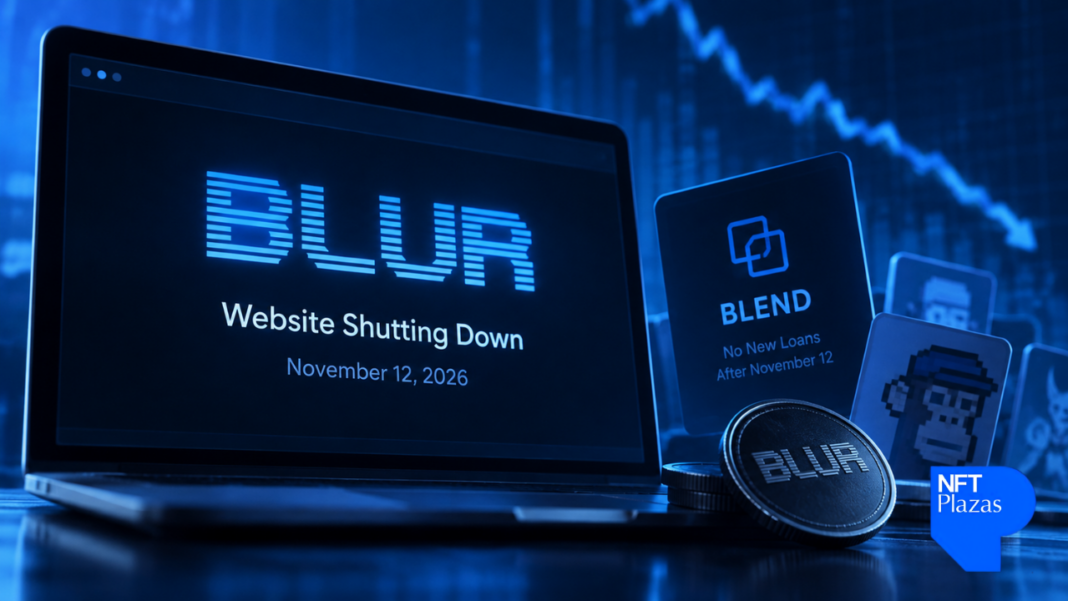

Ethereum NFT marketplace Blur will shut down its website on November 12, 2026, and stop arranging new loans through Blend, marking another setback for a platform that once dominated NFT trading.
The announcement, made on October 12, follows a prolonged decline in NFT activity and comes just ten days after Blast, an Ethereum layer-2 network developed by the same founding team, announced its closure.
Blur’s trading volume has fallen more than 99% from its 2023 peak. The news also sent its native BLUR token down more than 30% within 24 hours.
Despite the shutdown, Blur’s underlying marketplace protocol will remain operational on Ethereum, while BLUR holders will retain governance rights over its fee mechanism.

Blur’s announcement on X
Blur to Close Website and Wind Down Blend Lending
Blur will discontinue its blur.io website on November 12, ending access to its trading interface for NFT collectors and professional traders.
The closure applies only to the frontend, not the underlying smart contracts. Its on-chain marketplace infrastructure will remain functional, although users may need alternative interfaces to access it.
BLUR tokenholders will also retain control of the protocol’s fee switch, which determines whether marketplace trading fees can be introduced.
Meanwhile, Blend, Blur’s peer-to-peer NFT lending platform, will stop matching new loans on the same date.
Existing borrowers have until November 12 to repay outstanding loans or allow them to default under the protocol’s terms. Those who fail to settle their positions risk losing the NFTs used as collateral.
Blur said it would provide a separate tool after the deadline to help users withdraw eligible assets from Blend.
The distinction between closing the website and maintaining the protocol is important. Although transactions may remain technically possible through Ethereum smart contracts, the loss of Blur’s official interface could make trading less accessible to ordinary users.

BLUR price performance over the last 24h (Source: CoinGecko)
From OpenSea Rival to a 99% Trading Collapse
Launched in October 2022, Blur quickly challenged OpenSea by targeting professional NFT traders with faster transactions, bulk purchasing tools and zero marketplace fees.
Its growth accelerated following the BLUR token launch in February 2023, when an airdrop and rewards program encouraged trading activity.
By March 2023, Blur controlled more than 70% of Ethereum NFT trading volume, recording approximately $1.43 billion in monthly transactions.
The platform expanded into NFT-backed lending with Blend in May 2023, allowing users to borrow ETH against their digital collectibles.
However, the incentive-driven strategy became increasingly difficult to sustain as speculative demand weakened.
By March 2026, Blur’s monthly trading volume had fallen below $7 million, a decline exceeding 99.5% from its peak.
Its zero-fee model also limited direct marketplace revenue. Token Terminal records no protocol revenue from trading fees over the past three years, although that figure does not account for potential earnings from lending or other activities.
Critics previously questioned whether Blur’s rewards encouraged speculative trading and contributed to declining NFT prices. However, trading data alone cannot determine how much activity was driven by genuine demand rather than incentives.
Blur has not publicly attributed its website shutdown to operating losses.
NFT Market Struggles to Recover
Blur’s decline reflects broader weakness across the NFT industry, where trading activity remains far below the levels recorded during the 2021–2022 boom.
According to CryptoSlam, monthly NFT sales fell to $167.2 million in September 2026, compared with $554.8 million a year earlier and $1.78 billion in December 2023.
Statista projects global NFT market revenue of approximately $318.3 million in 2026, broadly unchanged from the previous year.
DappRadar has also reported that lower NFT prices have supported transaction counts despite declining overall sales volume.
The figures suggest that NFTs continue attracting buyers, but activity increasingly involves lower-priced assets rather than the expensive collections that previously dominated the market.
For platforms dependent on trading volume and token incentives, this shift presents a significant challenge to long-term sustainability.
Blast Shutdown Adds Pressure to Blur’s Ecosystem
Blur’s announcement follows the October 2 shutdown notice from Blast, an Ethereum layer-2 network founded by Tieshun Roquerre, better known as Pacman.
Blast attracted more than $2.3 billion in deposits ahead of its February 2024 mainnet launch, supported partly by yield opportunities and user rewards.
However, its assets reportedly declined to approximately $32 million by the time developers announced the closure.
The team said operating costs had exceeded revenue, making continued operations unsustainable.
Blast users have until October 26 to withdraw funds through its regular interface, ahead of Blur’s separate November 12 deadline.
Although Blur has not provided the same financial explanation for its decision, the consecutive closures highlight the challenges facing crypto projects that relied heavily on incentives to attract liquidity and users.
BLUR Token Slides as Security Concerns Surface
The announcement triggered a sharp selloff in BLUR, with the token reportedly falling more than 33% within 24 hours to approximately $0.012 on October 13. Its market capitalization declined to around $38 million.
Security concerns have also emerged over NFT permissions previously granted to Blur’s smart contracts.
Blockchain researcher 0xQuit said no existing vulnerabilities had been identified but warned that upgradeable contracts could pose risks if administrative controls were compromised or misused.
Users have been encouraged to review unnecessary approvals through tools such as Revoke.cash. Yuga Labs CEO Figge and Pudgy Penguins CEO Luca Netz also supported precautionary measures.
Meanwhile, a SushiSwap representative publicly expressed interest in acquiring Blur, although no formal negotiations or agreement have been confirmed.
Blur’s website closure does not mean its Ethereum protocol will disappear. However, with trading activity severely diminished and Blend winding down, its future relevance remains uncertain.
The retreat of both Blur and Blast also raises a broader question for the NFT industry: whether platforms built around aggressive trading incentives can remain viable once those rewards disappear.