
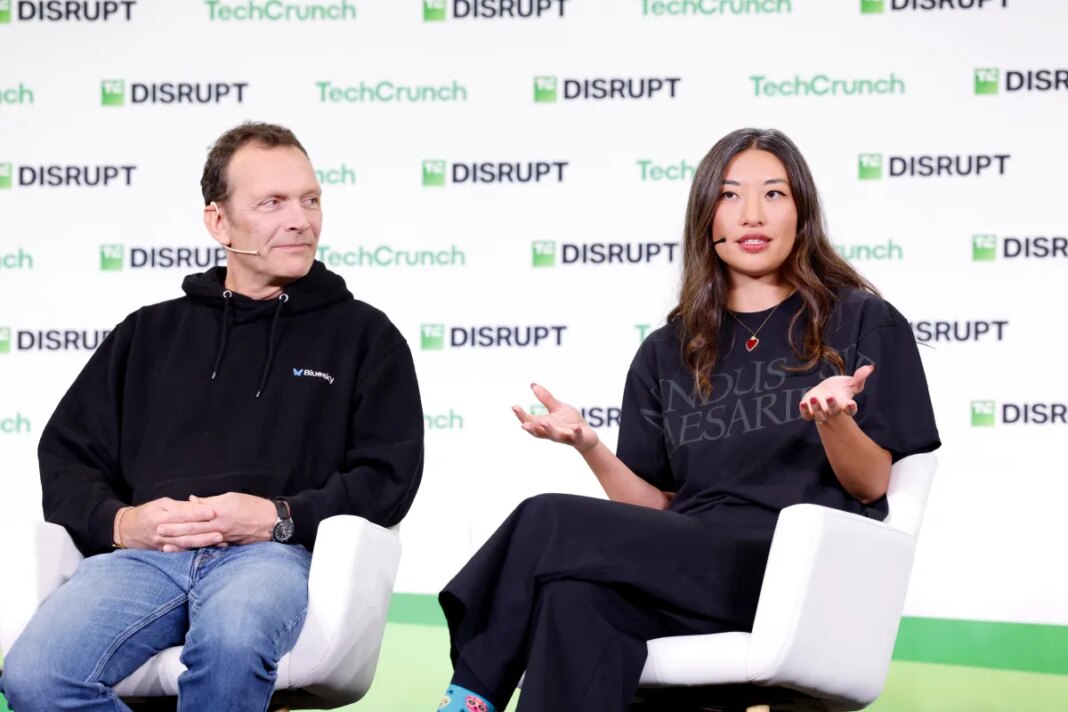

Bluesky plans to introduce payments in the coming months, a first step in its strategy to make money without relying on advertising. CEO Toni Schneider and COO Rose Wang outlined the plans Thursday at TechCrunch Disrupt, explaining how the company hopes to build on the commerce and fundraising activity already happening on its decentralized social network.
“People are actually selling things, fundraising very successfully, supporting each other on the network,” Schneider said. “We want to make that easier, and the way we’re going to do this is if you see something on the network that you like and support, you can support that monetarily, and we want to do it in a way that works for Bluesky and for all the other apps out there as well, so that it works across the entire network.”
Schneider, the former CEO of Automattic, took the reins of the company in March after longtime CEO Jay Graber stepped down. He said, while onstage, that he was surprised by the reaction to his appointment, with some users joking that it marked the beginning of the end for the platform. Those comments reflected fears that a leadership change would bring unwanted changes to Bluesky.
Schneider said he understands that users can leave Bluesky for another platform if the company introduces features or changes they dislike, a reality that he said keeps the leadership team accountable as it prepares to introduce monetization in the coming months.
The executives argued that advertising isn’t the only viable business model for a social network.

“I think there’s a story around monetization that feels like advertising is the inevitable thing we have to do that will ruin the network,” Wang said. “What was really promising about having Toni join us is he built at WordPress Automatic a $10 billion business where a billion of it goes back to the parent company and the rest of it goes to the ecosystem.”
Wang also pointed to Bluesky’s status as a Public Benefit Corporation (PBC), which she said puts the company’s mission at the center of its business strategy.
“Yes, we need to make money, but because of our infrastructure, we cannot lock people in,” Wang said. “And so the thing that really matters for us is the people who are creating value on the networks these days are the ones who are getting the value that is coming in or the money that’s coming in. And I kind of think of it as like feudal society where we’re working for a few landlords and they dictate everything, and then we have to pay up our dues as tariffs.”
Bluesky aims to give users ownership of their digital identities and control over their networks while creating a more open internet where value and revenue can flow directly to the people who generate them.
“First, we’ll start with payments, but I think it’s about disrupting the actual infrastructure layer, which is what we’re doing, and not just building another app,” Wang said.
When you purchase through links in our articles, we may earn a small commission. This doesn’t affect our editorial independence.