


The Court of Appeals (CA) has issued a Freeze Order targeting 25 virtual asset wallets, 86 bank accounts, four investment accounts, and an insurance policy tied to a prominent lawmaker and associated entities in connection with alleged anomalies in flood control projects and government kickbacks.
The resolution, dated September 21, 2026, was granted after the CA found probable cause that the covered assets are linked to plunder under Republic Act No. 7080.
Multi-Layered Laundering Scheme
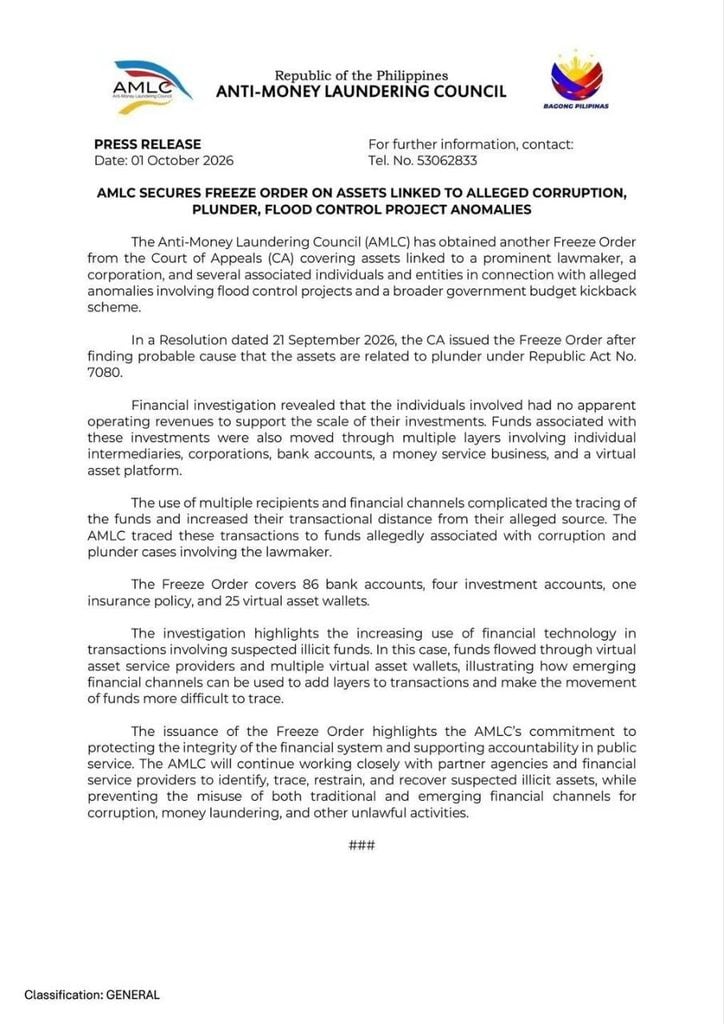
According to the Anti-Money Laundering Council (AMLC), financial investigations revealed that the individuals and entities involved lacked legitimate operating revenues to justify the scale of their investments.
To obscure the origin of the funds, the subjects allegedly funneled kickback proceeds through a complex network consisting of:
- Individual Intermediaries & Corporations acting as pass-throughs
- Traditional Financial Institutions, including multiple commercial bank accounts
- Money Service Businesses (MSBs) and fiat remittance channels
- Virtual Asset Service Providers (VASPs) and private crypto wallets to maximize transactional distance from the source
“The use of multiple recipients and financial channels complicated the tracing of the funds and increased their transactional distance from their alleged source,” the AMLC stated in a press release.
Breakdown of Frozen Assets
| Asset Type | Quantity Covered |
| Bank Accounts | 86 |
| Virtual Asset Wallets | 25 |
| Investment Accounts | 4 |
| Insurance Policies | 1 |
Shift to Crypto Laundering

The court’s freeze order follows disclosures from government officials regarding how cryptocurrency has been integrated into local public works corruption.
Undersecretary Renato “Aboy” Paraiso, chairperson of the Independent Commission for Infrastructure’s Technical Working Group (ICI-TWG), described the scheme as a “new phenomenon” in government corruption, revealing that contractors and personalities linked to the flood control scandal were systematically moving ₱50 million to ₱100 million per transaction into digital assets to hide the money trail and rapidly transfer funds to offshore financial havens. (Read More: Flood Control Scandal: Suspects Moved ₱100M per Crypto Transaction via Cold Wallets, P2P, and Exchanges, Gov’t Says)
Paraiso noted that while major exchanges maintain strict Know Your Customer (KYC) compliance, non-compliant platforms and peer-to-peer (P2P) channels continue to allow rapid capital movement. To counter this, law enforcement agencies have partnered with blockchain analytics platforms such as Chainalysis, global exchanges like Binance, and stablecoin issuers like Tether to trace and freeze illicit USDT transactions.
Regulatory Push on Digital Channels
The AMLC emphasized that the investigation highlights the increasing role of financial technology in transactions involving suspected illicit funds.
The council reaffirmed its commitment to working closely with partner agencies and financial service providers to identify, trace, restrain, and recover suspected illicit assets across both traditional banking and emerging digital financial channels.
This article is published on BitPinas: AMLC: Court Freezes 25 Crypto Wallets, 86 Bank Accounts in Flood Control Plunder Probe
What else is happening in Crypto Philippines and beyond?