
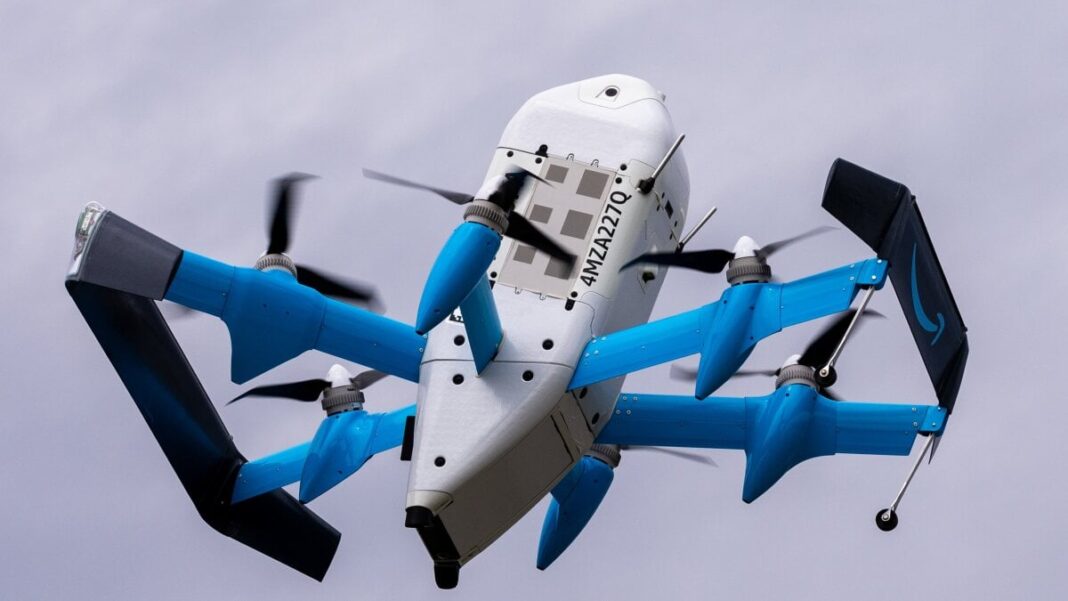

If Amazon gets its way, your next emergency phone-charger order may not arrive in a van, but buzz into your yard from the sky before you have time to forget you ordered it.
That possibility is about to become real for many more people. On Wednesday, Amazon announced that Prime Air will expand to nearly 500 cities and towns across the United States by the end of 2026. That would represent a sixfold increase from the drone service’s current footprint.
For now, Prime Air operates from just 11 sites spanning 10 metropolitan areas in Arizona, Florida, Kansas, Louisiana, Michigan, Nebraska, and Texas. Amazon plans to launch next in the Chicago, Syracuse, Cleveland, Atlanta, and Boise metro areas, with more communities expected to follow later this year.
Does that mean Amazon is building 500 new drone facilities? Not quite.
The company is counting every city and town reached by the service, rather than individual launch sites. Each existing Prime Air site covers an area of roughly 175 square miles, allowing one facility to serve multiple communities. Even then, not every address within a listed ZIP code will necessarily qualify, and Amazon has not yet published a full list of the nearly 500 places included in its plans.
If your address does make the cut, drone delivery will appear as an option while shopping and at checkout. Most products weighing 5 pounds or less and fitting inside a large shoebox are eligible, which Amazon says encompasses more than 60 percent of the items its customers purchase most frequently.
That leaves room for more than just a forgotten tube of toothpaste. Groceries, cosmetics, medications, electronics, and even products like iPhones, AirPods, Samsung Galaxy phones, and Ring doorbells can all potentially make the trip by drone.
Amazon says those orders can arrive in as little as 30 minutes, although most take closer to an hour. Prime members receive free drone delivery on orders of at least $50 and pay $2.99 for smaller orders. Non-Prime customers pay $4.99.
Mashable Light Speed
The sudden push to reach hundreds of communities has been a long time coming. Jeff Bezos first demonstrated Amazon’s drone delivery concept in 2013, and Prime Air began making deliveries to customers in 2022. Amazon now says the service has completed hundreds of thousands of deliveries this year and is making thousands more each day.
Part of what changed is how far Amazon is allowed to fly. The company holds the Federal Aviation Administration’s Part 135 air carrier certification, which is required for operators transporting other people’s property by drone beyond a pilot’s direct line of sight. In 2024, the FAA also gave Amazon additional permission to conduct those longer-range flights using its onboard detect-and-avoid technology.
Amazon says its drones independently monitor their surroundings using cameras and sensors. When a drone reaches its destination, it checks that the delivery area is clear of people, pets, and vehicles before releasing the package. The company says the cameras are used for navigation and obstacle detection, rather than tracking people, and that no employee watches a live feed.
Of course, sending autonomous aircraft over people’s homes presents more complicated risks than misplacing a package on the wrong porch. Prime Air’s path to expansion has already included several reminders of that.
Two Amazon drones collided with a crane in Tolleson, Arizona, in October 2025, prompting federal investigations and a temporary pause in local service. The following month, the FAA opened another investigation after a drone struck and severed an internet cable in Waco, Texas. No injuries were reported in either incident.
Amazon will not have the skies to itself, either. Its expansion comes as seemingly every major delivery platform tries to determine where drones fit into its network.
On July 29, DoorDash launched DoorDash Air after becoming the eighth drone operator to receive Part 135 certification. The company is developing its own aircraft and plans to place drones inside the same network that already assigns orders to human Dashers, ground robots, and autonomous delivery partners.
Alphabet-owned Wing, meanwhile, has completed more than 1 million commercial drone deliveries and is working with Walmart to build a network of more than 270 locations reaching more than 40 million Americans by 2027. Uber also partnered with Zipline on Aug. 17, which has completed more than 2 million deliveries globally, to bring drone delivery to Uber Eats.
The competition is intensifying just as the federal government makes it more expensive to source some of the technology from overseas. DoorDash has emphasized that its aircraft was designed in the United States and uses mostly American-made components. That distinction could become more valuable after President Donald Trump imposed new tariffs on foreign-made drones and components, including a 100 percent tariff on drones considered particularly sensitive to national security concerns.
For more than a decade, drone delivery has been a futuristic demonstration in search of an everyday use. If Amazon and its rivals hit their targets, the next phase will be much less theoretical: finding out whether people really need their toiletries badly enough to summon them from the sky.