

Ali Martinez has cautioned that Strategy’s STRC structure may amplify financial stress in a prolonged Bitcoin bear market, citing similarities to the feedback loop seen in Terra-Luna’s collapse in 2022.
Summary
- Ali Martinez warned that Strategy’s STRC structure could increase financial pressure during a prolonged Bitcoin decline.
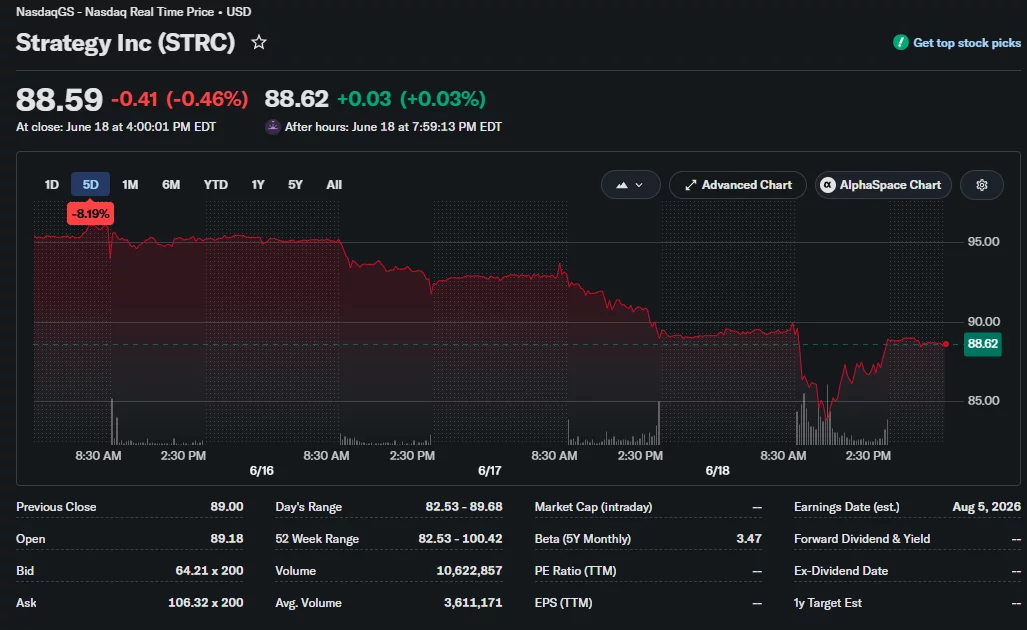
- STRC fell as much as 17% below its $100 par value, raising concerns about investor demand.
- Martinez said the stock’s feedback mechanism shares conceptual similarities with Terra-Luna’s collapse dynamics.
In a June 19 X post, Martinez argued that STRC differs from traditional corporate bonds because its dividend rate can be adjusted to help keep the security trading near its $100 par value.
While conventional bond issuers continue paying fixed interest regardless of market fluctuations, he said Strategy may face pressure to raise dividend payouts if demand for STRC weakens during a Bitcoin downturn.
The concern comes as scrutiny of Strategy’s financing model continues to grow following a sharp decline in its latest preferred stock offering.
As reported by crypto.news earlier, STRC fell as much as 17% below par value on June 18, reaching a record low of $82.53 before recovering to close at $88.59.
Rising payouts could increase pressure during a Bitcoin decline
Martinez said the structure creates a situation in which Strategy’s financing costs could rise at the same time that the value of its primary treasury asset falls. If Bitcoin remains under pressure and investor demand for STRC declines, the company may need to offer higher dividends to attract buyers and support the stock’s market price.
According to Martinez, additional cash commitments tied to higher payouts could become increasingly burdensome during a prolonged market downturn.
His assessment arrives as investors debate how Strategy should respond to the weakness in STRC. Arca Chief Investment Officer Jeff Dorman recently noted that selling between $3 billion and $4 billion worth of Bitcoin could be one way to relieve pressure on the company’s capital structure.
As reported by crypto.news, Dorman assigned a 25% probability to a large Bitcoin sale and said such a move could provide flexibility while helping restore confidence in STRC. He nevertheless viewed continued sales of MSTR shares as the more likely outcome, assigning that scenario a 70% probability.
Terra comparison focuses on incentives rather than mechanics
While drawing comparisons to Terra-Luna, Martinez emphasized that Strategy is fundamentally different from the failed stablecoin ecosystem. He noted that Strategy does not rely on algorithmic tokens or token minting mechanisms, which played a central role in Terra’s collapse.
Instead, his warning focused on what he described as a similar economic dynamic. Martinez argued that both systems place additional financial burdens on the issuer as conditions deteriorate, rather than reducing pressure during periods of stress.
“It is conceptually similar to the Terra/Luna collapse,” Martinez wrote.
Expanding on that view, he said a sustained Bitcoin decline could force more capital toward supporting STRC around its $100 par value. According to Martinez, this could create a “dangerous loop” where falling asset values coincide with increasing financial obligations.
Additional concerns surrounding Strategy’s liquidity position have also emerged in recent weeks. Earlier, market maker QCP estimated that the company’s available liquidity could cover preferred dividend payments for roughly seven and a half months.
At the same time, longtime Bitcoin critic Peter Schiff has questioned how STRC was marketed to investors, arguing that the stock’s decline could eventually raise Strategy’s future fundraising costs if buyers begin demanding higher yields to hold similar securities.