

Key Takeaways
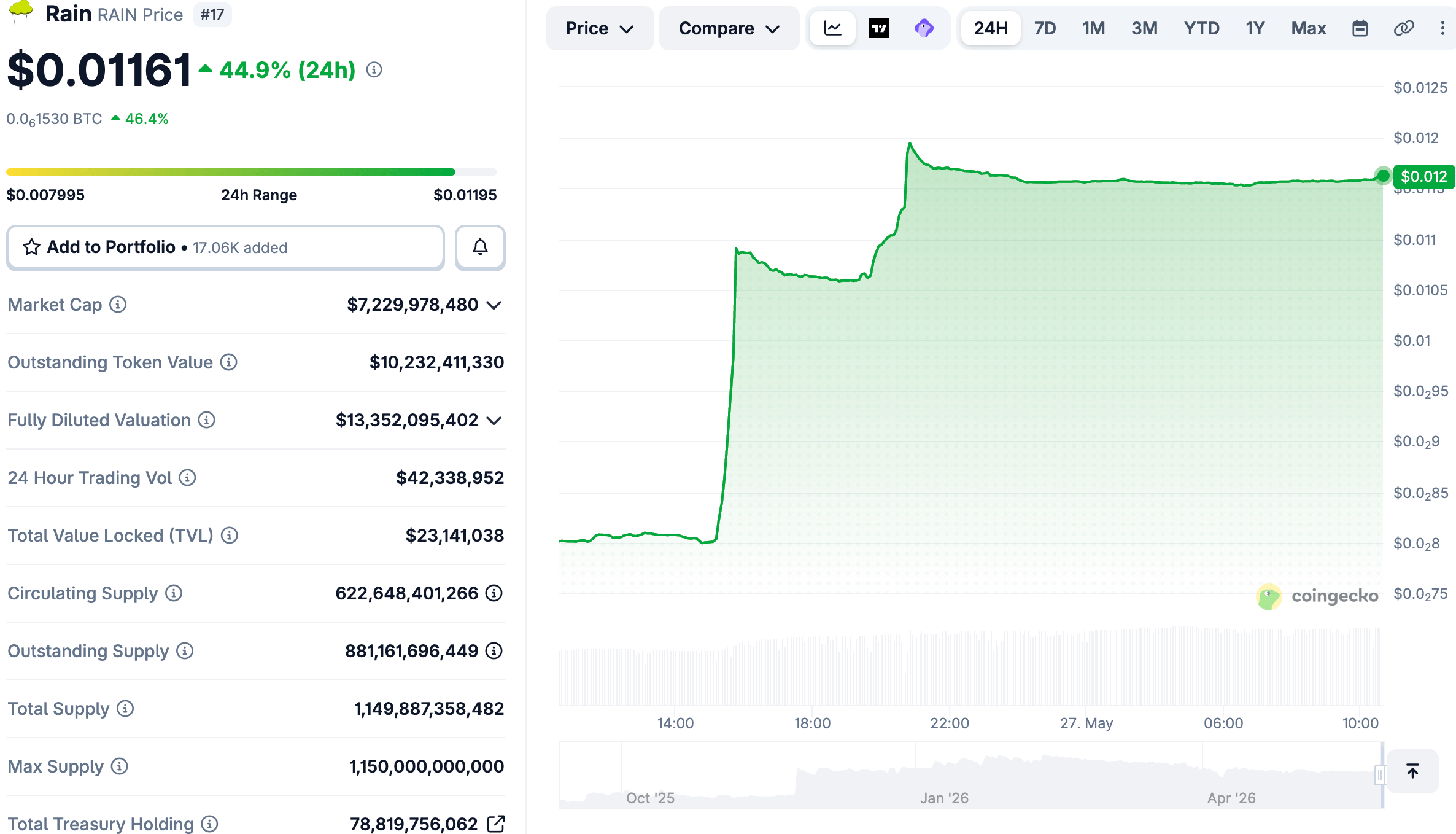
- RAIN surged 44% to a record $0.01195 after a $100 million injection from the Rain Foundation on May 26.
- Rain became the No. 3 prediction market by TVL, trailing only Polymarket and Kalshi.
- Observers debate whether RAIN’s built-in burn mechanism can offset its massive 1.15 trillion max supply.
Rain Token Hits All-Time High
The native token of the prediction markets protocol Rain jumped 44% to reach an all-time high of $0.01195 just hours after the Rain Foundation injected $100 million into the platform. The surge allowed RAIN to overtake several high-capitalization altcoins—including bitcoin cash, monero, and chainlink (LINK)—as it burst into the top 20 ranked coins. Market data showed RAIN’s market capitalization reached $7.2 billion, a threshold that ranks 17th on Coingecko.
According to a May 26 post on X, the Rain Foundation’s injection made the protocol the No. 3 prediction market platform by total value locked (TVL), trailing only Polymarket and Kalshi. The capital, which appears timed to coincide with the football World Cup, is evenly split between the stablecoin USDT and RAIN tokens.
“The allocation consists of $50M in USDT and $50M in RAIN, flowing directly into the smart contract to deeply capitalize our prediction markets, back liquidity, tighten spreads, and support high- volume trading,” the foundation explained in the post.
The influx of capital aims to create unmatched depth and minimal slippage for traders. On X, the user Forecaster highlighted the broader market impact, noting that the move addresses the liquidity bottlenecks and trading friction that have held back decentralized prediction platforms. For developers, the massive backing provides a highly capitalized environment to launch custom applications and attract market makers.
Despite the immediate price surge, RAIN’s long-term upward potential has sparked debate due to its vast tokenomics. The asset has a circulating supply of more than 622.6 billion tokens and a maximum supply of 1.15 trillion.
Critics, including X user Web3insiderguy, pointed out that this massive circulating supply creates significant overhead pressure. They argue that sustaining higher price levels could prove difficult without token burns or additional utility sinks to offset future dilution.
However, proponents counter that RAIN already features a built-in burn mechanism designed to significantly reduce the circulating supply over the long term.