
Key Takeaways
- Layer one (L1) blockchain Ontology halted block production Oct. 10 and resumed operations Oct. 12 after a security warning.
- Ontology reported no network-level losses, but the affected ecosystem project’s identity remains undisclosed.
- Ontology has now experienced two security-related blockchain shutdowns in approximately six weeks.
Security Warning Brings Ontology Blockchain to a Halt
The trouble began Saturday, Oct. 10, when Ontology announced that an urgent security report had raised concerns about a project operating on its blockchain. The potential threat was serious enough for the team to coordinate with a majority of consensus nodes and suspend block production. That meant the network temporarily stopped adding new transactions to its blockchain, an extraordinary precaution for infrastructure designed to operate continuously.
Ontology’s announcement described the situation as a potential threat to network assets, although it didn’t identify the affected project or disclose the suspected vulnerability. The interruption lasted approximately 41 hours, from the initial announcement around 16:43 UTC Saturday until Ontology confirmed normal operations at approximately 09:57 UTC Monday. Some exchanges, including Bitget and South Korea’s Coinone, suspended deposits and withdrawals involving Ontology-network assets during the disruption.
Network Restarts With No Reported Losses
On Monday, Ontology confirmed that mainnet block production had resumed following its investigation. The team maintained that its core infrastructure remained secure and that no funds had been lost from the Ontology network itself. There’s a catch, however. That assurance doesn’t establish whether the unidentified ecosystem project experienced losses or whether its users faced financial exposure.
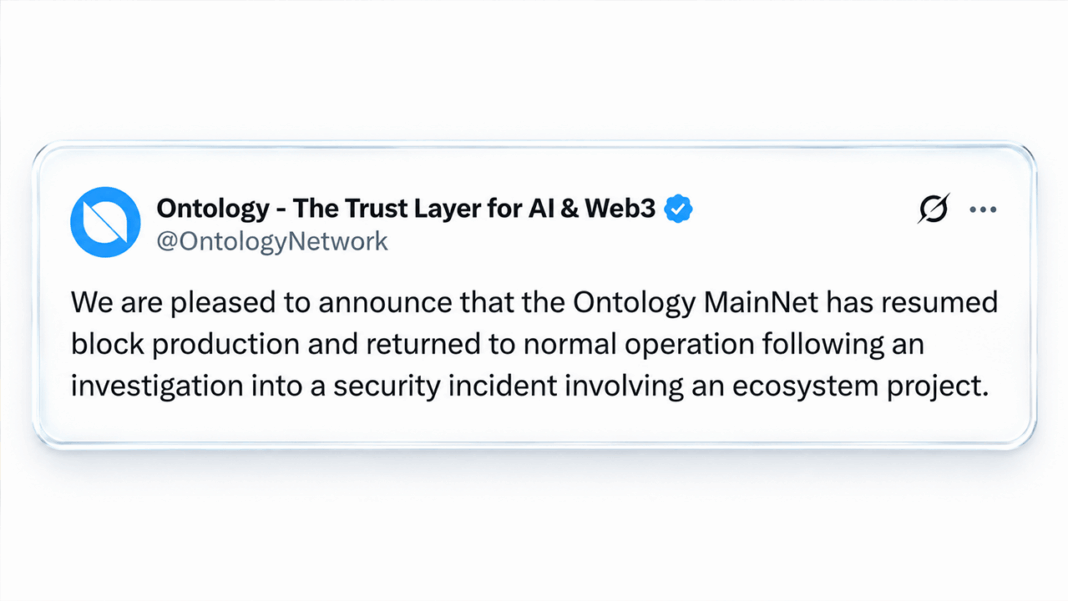
No technical explanation, independent forensic assessment, or detailed public post-mortem accompanied the initial recovery announcement. “We are pleased to announce that the Ontology MainNet has resumed block production and returned to normal operation following an investigation into a security incident involving an ecosystem project,” the Ontology X account stated.
The project’s X account added:
“Ontology’s core infrastructure remains safe, with no funds lost from the Ontology network itself. The temporary suspension was a precautionary measure taken in coordination with consensus nodes to support the investigation and mitigate potential risks. We thank our consensus nodes, exchange partners, and community for their patience and cooperation.”
The episode also exposed an interesting factor used in several blockchain operations. Ontology uses a consensus system called Verifiable Byzantine Fault Tolerance (VBFT), which combines staking mechanisms with coordinated validation. That specific architecture allowed participating nodes to collectively stop the network when operators believed the risk warranted intervention.
Second Ontology Shutdown
Interestingly, this wasn’t Ontology’s first emergency shutdown in 2026. On Aug. 31, the blockchain suspended production following a security alert that subsequently developed into confirmed malicious activity targeting the network. Operations resumed around Sept. 2 after remediation and a mandatory software upgrade. Other networks have faced comparable emergencies.
Cronos validators halted production Aug. 30 following an exploit involving the Tectonic lending protocol. Operators subsequently rolled back approximately 10,000 to 11,000 blocks, effectively reversing roughly two hours of blockchain history.
ICON, Injective and MultiversX also experienced security-related interruptions during August and September, although their circumstances and recovery procedures differed. Ontology’s latest episode involved a precautionary pause rather than a disclosed compromise of its underlying protocol.
The larger unanswered question concerns the project that triggered the latest emergency. Ontology restored its blockchain, but the public still hasn’t learned precisely what threatened it.