Key Takeaways
- Polymarket is running Protocol V2 canary markets from Oct. 5 to Oct. 30 before a tentative Nov. 2 switchover.
- V2 swaps the 2019 Gnosis token framework for one ERC-1155 contract, pUSD collateral, and one router.
- Regulated U.S. prediction markets did $68.18 billion in 30-day volume recently, with Kalshi at 73.4% and Polymarket U.S. at 12.2%.
What Has Been Running Under the Hood Since 2019
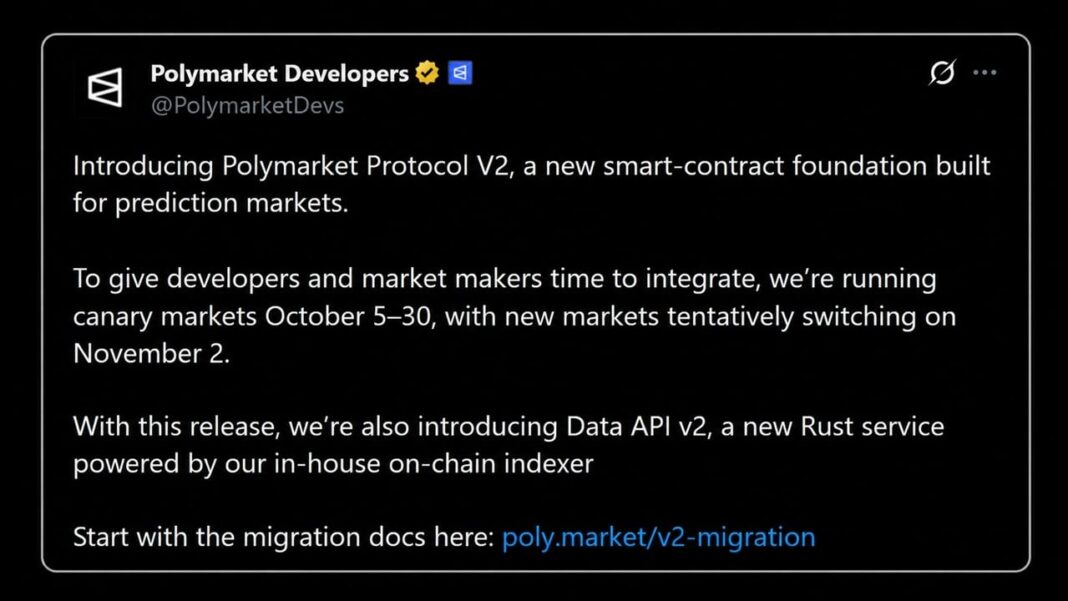
Polymarket’s developer account introduced Protocol V2 on Monday as “a new smart-contract foundation built for prediction markets.” The upgrade, led by head of protocol Rajath Alex, replaces the platform’s legacy 2019 foundation, the Gnosis Conditional Tokens Framework (CTF).
CTF has carried Polymarket’s markets for years, but the goal of the latest rewrite is to eliminate any “architectural bloat.” Smart contract auditor Quantstamp described the result as a single exchange, collateral token, and router that handle every market type.
Old Stack vs New Stack
The design notes shared at the time of launch break the change into a handful of swaps:
- Positions: Every outcome share lives in one ERC-1155 contract, a token standard that lets a single contract track many token types at once.
- Collateral: One asset, Polymarket USD (pUSD), an ERC-20 token on Polygon backed by USDC, with the backing enforced onchain.
- Trading: One exchange for every market type, with a router directing orders.
- Market types: Binary, atomic neg-risk, incremental neg-risk, and combinatorial markets at launch, each as a module.
- Resolution: A new OracleAggregator with pluggable modules for UMA, Chainlink, and potential future oracles.
- Bridging: Positions, collateral, and resolutions are designed to move across chains, to be switched on when Polymarket goes multichain.
Each position ID also encodes its market type, market, and outcome, so the protocol can read what a token is straight from its ID.
What Do Users Need to Do?
For ordinary users, very little, as Polymarket’s migration guide says app and website users need no technical migration beyond approving prompts in the app. Existing CTF holdings will not be converted, and old markets running on the old framework continue to do so until they resolve.
Developers and market makers carry the real workload as they get the canary window from Oct. 5 to Oct. 30 to add V2 support, with new markets tentatively switching on Nov. 2. The contracts have been formally verified by Certora, and Polymarket is offering a bug bounty of up to $5 million for critical flaws.
This is Polymarket’s second big rebuild of the year, as earlier in April, Polymarket moved its order book to CLOB V2 and replaced bridged USDC.e with pUSD, a cutover that wiped every resting order. Protocol V2 goes one layer deeper to the tokens themselves, but it leaves existing positions alone.
The Numbers Driving Prediction Markets
Bitcoin.com News reported recently that regulated U.S. prediction markets cleared $68.18 billion in the 30 days to Sept. 29. Kalshi took $50 billion of that, a 73.4% share, while Polymarket U.S. grew 127% to $8.3 billion, a 12.2% share. Kalshi’s grip on combination bets also slipped, from 93.5% to 83.9%, so a native combinatorial module looks like a direct play for that business.
Moreover, it bears mentioning that Polymarket just took the Dutch gambling regulator to court over its ban—a reminder that the platform is fighting on product and policy at the same time.