
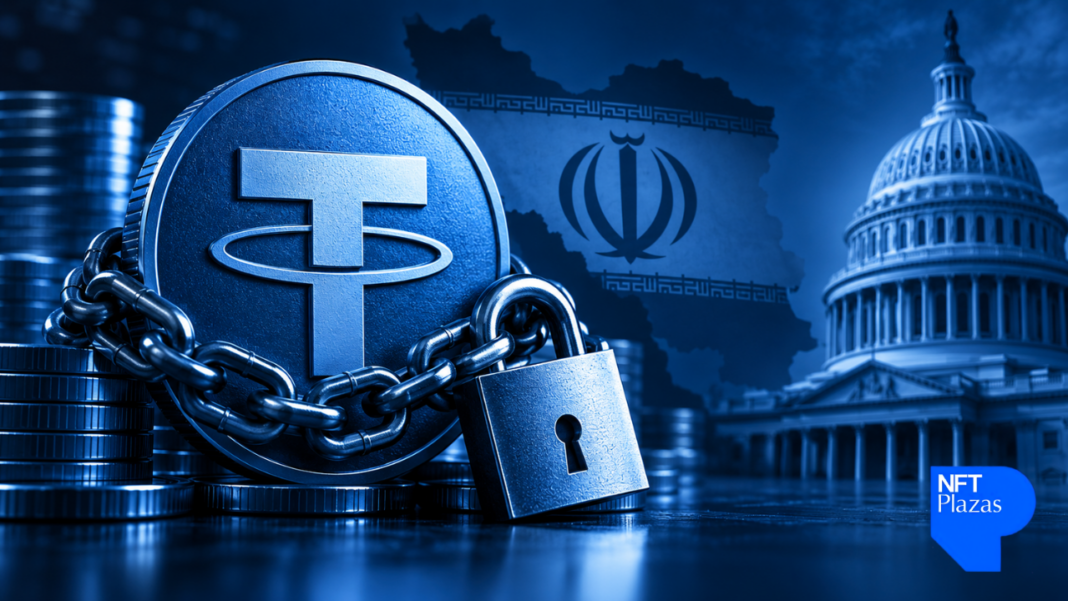

Tether says it helped authorities freeze nearly $550 million in Iran-linked USDT during 2026, highlighting the growing role of stablecoins in sanctions enforcement while drawing renewed scrutiny from U.S. lawmakers.
The company disclosed on September 28 its actions against wallets connected to Iran’s central bank and other sanctioned networks. The announcement followed a report from Democratic investigators on the Senate Permanent Subcommittee on Investigations alleging that USDT has become a major channel for Iranian entities to move money outside the traditional financial system.
The developments underscore a tension at the heart of stablecoins: the same infrastructure that enables fast cross-border transfers also gives investigators a transparent record of transactions.

Tether Details Nearly $550 Million in Freezes
Tether said it froze more than $344 million in USDT across two addresses in April after receiving information from the U.S. Treasury Department’s Office of Foreign Assets Control (OFAC) and U.S. law enforcement. OFAC added both addresses to its sanctions designation for Iran’s central bank the following day, citing links to the Islamic Revolutionary Guard Corps-Qods Force and Hezbollah.
In July, Tether froze more than $130 million across four TRON wallets after Treasury added those addresses to the same designation. Together, the two actions account for most of the company’s roughly $550 million in Iran-linked freezes this year.
The company stressed that freezing cryptocurrency is different from a government seizure. A freeze prevents USDT held at a specific address from being transferred, while ownership can be transferred to the government only through a separate legal process.
Tether CEO Paolo Ardoino said the company’s ability to respond to law enforcement requests shows the value of public blockchains in tracking financial activity.
“Tether has consistently demonstrated that USDT is not a haven for sanctioned actors, terrorist organizations or criminal networks,” Ardoino said.
Tether added that its cooperation with authorities worldwide has helped freeze more than $4.9 billion in assets, including more than $2.4 billion connected to U.S. authorities.
Senate Report Raises Concerns Over USDT
The Senate investigation takes a more critical view of USDT’s role in Iran-linked financial activity. Investigators examined 846 cryptocurrency wallets sanctioned or targeted for seizure over their connections to Iran and its proxies, and found that 84% had transacted exclusively or nearly exclusively in USDT. They also traced more than $600 million in USDT through the accounts of two sanctioned Iranian oil smugglers between 2021 and 2025.
The report argues that USDT’s liquidity and wide availability make it an important payment rail for Iranian networks seeking to bypass banking restrictions, and says some transactions connected Iranian banks with financial networks associated with Hezbollah and the Houthis.
Senator Richard Blumenthal called on the Treasury and Justice departments to investigate potential sanctions violations and examine Tether’s role in transactions involving Iranian networks.
The Senate findings are investigative allegations, not a legal determination that Tether violated U.S. law. Tether has rejected the characterization that USDT provides a safe haven for sanctioned actors, pointing instead to its cooperation with authorities and its record of freezing identified wallets.
U.S. Sanctions Increasingly Target Digital Assets
The dispute comes as Washington expands its use of sanctions against Iran-linked cryptocurrency activity. In August, the Treasury Department launched Operation Economic Outcast, targeting financial networks supporting Iran, with digital assets included alongside technology, gold, aviation and shipping among the sectors facing expanded measures.
The campaign continued in September, when OFAC sanctioned BitBank, an Iranian digital-asset venture, along with its software developer and several associates of financier Babak Zanjani. Treasury alleged that Zanjani’s network used digital-asset businesses to move funds for the Islamic Revolutionary Guard Corps.
A separate Justice Department case shows how a Tether freeze can lead to forfeiture. In September, federal prosecutors sought forfeiture of about $61 million in USDT across 10 TRON addresses that Tether had previously frozen, alleging the funds were proceeds from Iranian oil sales intended to benefit Iran’s government and military-linked organizations. That case is not included in Tether’s $550 million figure.
USDT’s Scale Puts Compliance Under Pressure
The developments come as USDT continues to operate at enormous scale across global cryptocurrency markets. That scale creates a difficult compliance challenge. Stablecoins move value quickly across borders, and public blockchains leave records that help investigators trace suspicious flows. But the volume of activity means monitoring systems must flag sanctioned addresses and suspicious patterns before funds can be moved elsewhere.
That challenge could grow as faster blockchain infrastructure expands stablecoin payment capacity. StableChain, for example, has targeted speeds of up to 10,000 transactions per second, potentially supporting much larger payment flows.
For Tether, issuer-level controls remain a key enforcement mechanism. The blockchain itself does not determine whether a transaction complies with sanctions; issuers, exchanges, regulators and law enforcement each play a role in identifying and restricting illicit activity.
The Iran case highlights both sides of USDT’s growing importance. Blockchain transparency gives authorities a powerful tool for tracking illicit flows, while USDT’s liquidity and global accessibility can make it attractive to sanctioned networks.
Tether’s nearly $550 million in freezes shows that issuer intervention can block substantial funds once authorities identify targeted wallets. The Senate investigation, however, raises a broader question: whether those controls can keep pace with the growing use of stablecoins in sanctions-sensitive markets.
As U.S. authorities sharpen their focus on digital assets, Tether’s compliance practices are likely to face increasing scrutiny.